Email remains one of the most powerful marketing channels. However, if your messages never reach your audience, your entire strategy collapses. Many brands experience low open rates, high bounce rates, and dropping deliverability without understanding the root cause. In most cases, these problems start with poor-quality email lists. That’s exactly where email validation becomes essential.
In this guide, we’ll explore why emails fail, how email validation protects your campaigns, and the strategies you can apply immediately to secure inbox placement and long-term growth.
What Is Email Validation?
Email validation or Email Verification is the process of verifying whether an email address is active, deliverable, and safe to send to. It checks for:
-
Syntax errors
-
Domain verification
-
Disposable email detection
-
Spam traps
-
Role-based emails
-
Typo fixes
-
Mailbox existence
When done correctly, email validation helps you eliminate high-risk contacts before launching campaigns.
Why Your Emails Fail Before Reaching the Inbox
Most marketers assume that low performance is due to weak content. However, the real problem often begins before the email is delivered. Here are the hidden reasons behind failed campaigns:
1. 1High Bounce Rates
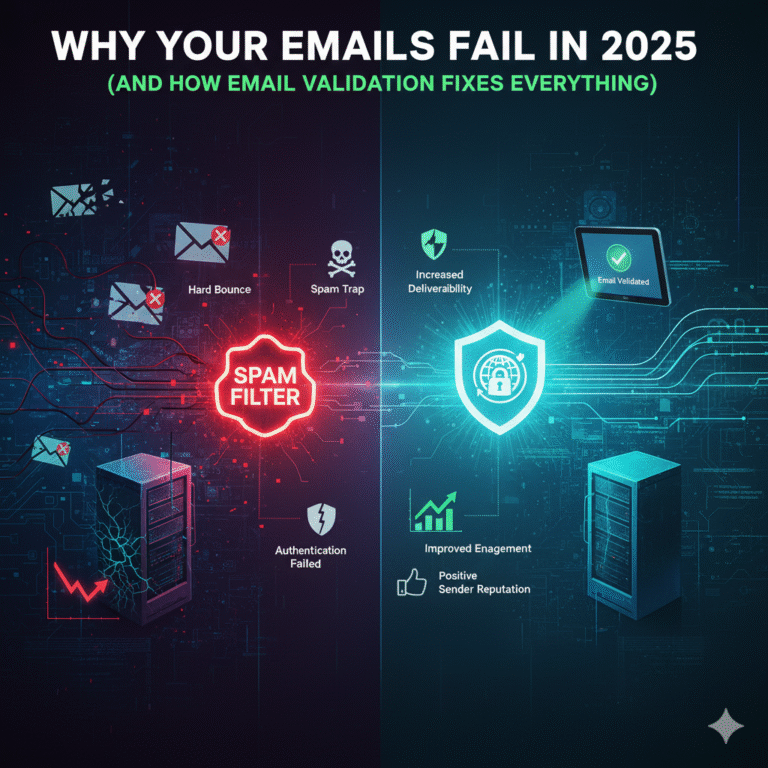
Hard bounces occur when an email address doesn’t exist, while soft bounces happen due to temporary issues. Sending messages to invalid contacts signals email providers that you are “spamming,” drastically hurting your sender score.
This is the first major issue that email validation solves.
1.2 Spam Traps in Your List
Spam traps are email addresses created by email providers to catch senders with poor acquisition practices. If you accidentally send emails to spam traps, your domain may face long-term deliverability issues.
1.3 Low-Quality or Purchased Email Lists
Purchased lists often contain:
-
Dead emails
-
Fake sign-ups
-
Temporary email addresses
-
Bots
Even one campaign sent to such lists can damage your domain reputation for months.
1.4 Poor Inbox Placement
If your list is full of invalid contacts, ISPs like Gmail and Outlook automatically shift your emails to:
✔ Promotions
✔ Spam
✔ Junk
Even perfectly written emails fail to perform.
1.5 Lack of Regular List Hygiene
Email lists decay at 22–30% per year. Without regular cleaning, the number of invalid contacts keeps increasing — harming your deliverability every single month.
This highlights why email validation is not optional. It is a core part of email marketing hygiene.
How Email Validation Fixes Failed Email Campaigns
Let’s break down how implementing validation changes everything for your email marketing strategy.
3.1 Email Validation Reduces Bounce Rates
Email verification removes invalid, fake, and inactive emails. Lower bounce rates directly improve your sender reputation, ensuring email providers trust your domain again.
3.2 Improves Deliverability
With a healthier list, inbox placement improves. More of your emails reach the primary inbox instead of spam — dramatically increasing open and click rates.
3.3 Protects Your Domain Reputation
Once your domain reputation drops, recovering it is extremely difficult. Email verification prevents this damage, helping you maintain a strong digital identity.
3.4 Helps You Identify High-Risk Leads
Validation tools detect:
-
Disposable emails
-
Temporary domains
-
Spam trap indicators
-
Bot-created accounts
Removing them keeps your segmentation accurate and your conversion rates higher.
3.5 Enhances Overall ROI
Every invalid email wastes:
❌ Time
❌ Server resources
❌ Sending credits
By validating emails, you’re paying only for real, engaged, deliverable contacts — maximizing your campaign ROI.
4. Benefits of Using Email Validation Regularly
When used consistently, email verification offers long-lasting advantages:
-
Higher open rates
-
Stronger segmentation
-
Better automation workflow performance
-
More accurate analytics
-
Improved sender authority
-
Fewer complaint rates
-
Better inbox health
It ultimately builds a clean, responsive, and trustworthy list.
5. Best Practices for Effective Email Verification
Follow these strategies to maintain list hygiene:
5.1 Validate Emails at the Point of Entry
Use real-time validation during sign-ups and lead forms to block low-quality addresses from entering your list.
5.2 Clean Your Database Every 30–60 Days
This ensures old, inactive, or invalid emails are removed regularly.
5.3 Avoid Buying Email Lists
These lists contain high-risk contacts and spam traps that can destroy your domain reputation.
5.4 Use a High-Quality Validation Tool
A reliable tool detects advanced issues like SMTP response anomalies, role-based emails, and disposable domains.
5.5 Monitor Engagement Metrics
If subscribers haven’t opened your emails for months, revalidate them or move them to a re-engagement sequence.
FAQs About Email Validation
Q1. Is email validation necessary for small businesses?
Yes. Even small lists contain invalid or unsafe emails. Regular validation protects your sender reputation and improves performance across all campaigns.
Q2. How often should I validate my email list?
Ideally every 30–60 days, depending on how fast your list grows and how frequently you run campaigns.
Q3. Does email validation improve deliverability?
Absolutely. Validation removes risky addresses, lowering bounce rates and ensuring your domain remains trusted by email providers.
Q4. Can email validation detect spam traps?
Good validators identify suspicious patterns, temporary domains, and inactive mailboxes — helping you avoid spam traps.
Q5. Is email validation the same as double opt-in?
No. Double opt-in confirms user intent, while email validation checks the technical deliverability of the email address.